
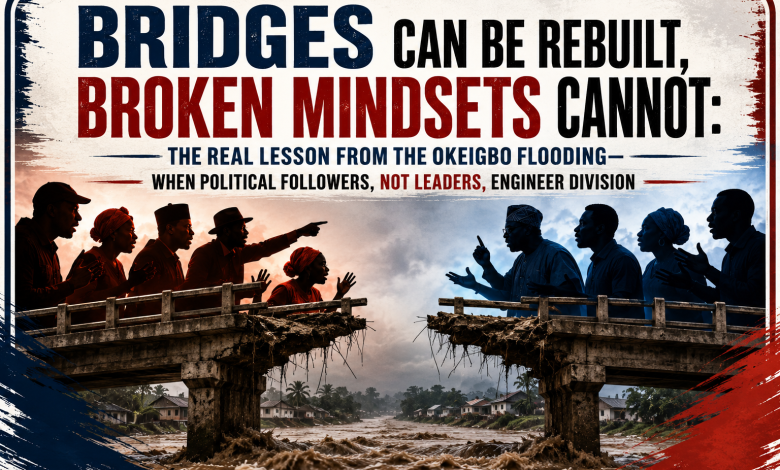
Bridges Can Be Rebuilt, Broken Mindsets Cannot: The Real Lesson from the Okeigbo Flooding—When Political Followers, Not Leaders, Engineer Division

By Onawumi Ayochris
The recent flooding in Okeigbo did more than destroy roads, bridges, and livelihoods; it exposed a deeper problem within our political culture. While public office holders must always be held accountable, the conduct of some political followers has become an equally serious obstacle to development. Instead of allowing facts and compassion to guide public discourse, the disaster quickly became another platform for political attacks, personal vendettas, and partisan arguments. In moments that should unite a community, division often takes centre stage.
Following the flood, the local government reportedly brought the situation to the attention of the Ondo State Government, leading Governor Lucky Orimisan Aiyedatiwa to direct prompt attention to the affected areas. At the federal level, Hon. Festus Adefiranye, representing Ileoluji/Okeigbo and Odigbo Federal Constituency, raised the matter on the floor of the House of Representatives, calling for urgent intervention and improved drainage infrastructure. Yet, rather than encouraging every genuine effort to attract relief, some questioned why the federal lawmaker became involved because the affected road was not a federal road. Such criticism overlooks the essence of representation. An elected representative is expected to speak for the people and seek assistance wherever it can be found, irrespective of which tier of government has primary responsibility.
The same pattern was evident in the criticism directed at the Executive Chairman of Ileoluji/Okeigbo Local Government, Hon. Adebare Adeboye. While citizens have every right to demand prompt action and accountability, it was also noticeable that some reactions appeared to be driven as much by longstanding political disagreements and personal grievances as by the flooding itself. When genuine concerns become mixed with old political scores, public debate shifts from finding solutions to settling personal or partisan disputes. Accountability is strengthened by facts and fairness, not by hostility.
The lesson from Okeigbo is that development requires more than capable leaders; it requires responsible followers. Democracy flourishes when citizens criticise with evidence, acknowledge sincere efforts regardless of political affiliation, and encourage collaboration among local, state, and federal authorities. Government also has its obligations, while citizens must play their part by protecting drainage systems, avoiding indiscriminate waste disposal, and supporting community efforts to reduce the impact of flooding.
The future of Okeigbo will not be determined solely by those who occupy political offices but also by the character of its followers. Leaders should be criticised when they fail and commended when they perform. Likewise, every sincere intervention—whether from the Local Government Chairman, the Governor, or Hon. Festus Adefiranye—should be judged on its merit rather than through the lens of political loyalty or past grievances. When followers choose truth over bias and solutions over bitterness, the entire community stands to benefit.