

{PART I}: The Making of a Diplomat and Nigeria’s Renewed Global Voice
How a lawyer, scholar, entrepreneur and senator stepped onto the world’s foremost diplomatic stage with an ambition to amplify Nigeria’s influence in global governance.
There are moments in the life of a nation when diplomacy quietly alters the course of history. They rarely announce themselves with fanfare. Instead, they unfold in conference rooms where consensus is negotiated, in committee chambers where global priorities are financed, and in the measured language of ambassadors whose words can shape international outcomes.
For more than six decades, Nigeria has been an active participant in that diplomatic enterprise.
Since gaining independence in 1960 and joining the United Nations the same year, Nigeria has pursued a foreign policy rooted in African solidarity, multilateral cooperation and international peace. Nigerian diplomats have helped shape debates on decolonisation, apartheid, peacekeeping, sustainable development and regional security, earning the country a reputation as one of Africa’s most influential voices in global affairs.
Yet diplomacy, like history itself, is never static.
As the international order confronts renewed geopolitical rivalry, climate change, humanitarian crises, technological disruption and demands for reform of global institutions, nations are increasingly judged not only by the size of their economies or militaries, but also by the effectiveness of those who represent them in multilateral institutions.
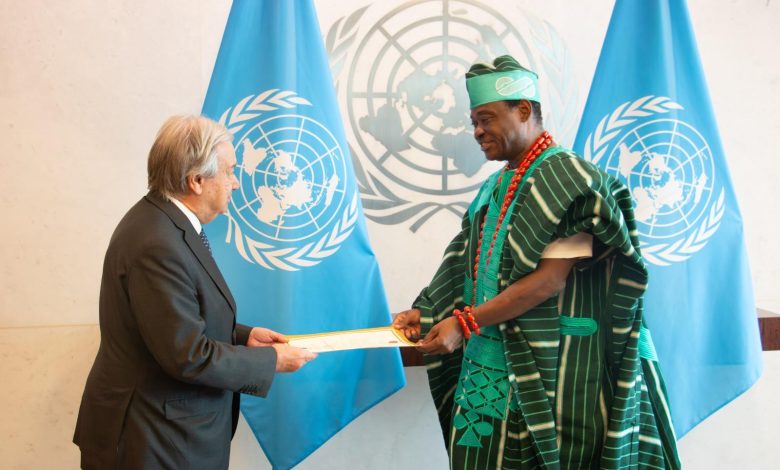
It is within this evolving landscape that Ambassador (Senator) Jimoh Ibrahim, CFR, Ph.D., assumed office as Nigeria’s Permanent Representative to the United Nations.
His appointment by President Bola Ahmed Tinubu was more than a diplomatic assignment. It reflected Nigeria’s determination to strengthen its engagement with an international system undergoing profound transformation.
Unlike many career diplomats, Ambassador Ibrahim arrived in New York with an unusually broad public profile.
His journey has traversed law, business, academia and legislative service. As a legal practitioner, entrepreneur, university founder, scholar and former senator, he accumulated experience across multiple sectors before assuming one of Nigeria’s most strategic diplomatic responsibilities.
That multidisciplinary background has shaped an approach that views diplomacy not merely as political representation but as an instrument for economic cooperation, institutional influence, legal engagement and intellectual leadership.
Barely had Ambassador Ibrahim settled into his new assignment before an important development underscored Nigeria’s renewed visibility within the United Nations.
He was elected Chairman of the United Nations General Assembly’s Fifth Committee, the principal body responsible for administrative and budgetary affairs across the United Nations system.
To many outside diplomatic circles, such a committee may appear procedural. In reality, it occupies a pivotal position within the Organisation.
The Fifth Committee examines and recommends decisions on the United Nations programme budget, peacekeeping financing, staffing, governance and administrative reforms. Virtually every United Nations operation, from humanitarian assistance and development programmes to conflict resolution missions, depends on decisions shaped through its work.
Presiding over such a committee requires technical competence, diplomatic dexterity and, above all, the confidence of fellow member states.
For Nigeria, Ambassador Ibrahim’s election represented more than an individual accomplishment. It demonstrated that a Nigerian diplomat had been entrusted with steering deliberations on issues central to the effective functioning of the world’s foremost multilateral institution.
President Bola Ahmed Tinubu described the election as a significant recognition of both Ambassador Ibrahim’s capabilities and Nigeria’s growing diplomatic relevance, noting that it came at a period when the United Nations continues to confront complex financial and institutional challenges.
The responsibilities of a Permanent Representative extend far beyond delivering national statements before the General Assembly.
Modern diplomacy demands coalition building, policy negotiation, strategic advocacy and the cultivation of relationships capable of advancing national interests within increasingly complex international institutions.
Ambassador Ibrahim has publicly articulated a vision consistent with that broader understanding.
In his engagements with Nigerian professionals serving across the United Nations system, he has repeatedly emphasised the importance of expanding Nigeria’s presence in key international institutions, not simply through diplomatic representation but through the appointment and election of qualified Nigerians to positions where global policies are formulated and implemented.
Such an approach reflects an appreciation that contemporary influence is exercised not only by ambassadors but also by economists, jurists, scientists, development specialists, humanitarian experts and administrators whose expertise shapes international decision making.
For decades, Nigeria has projected itself as a nation committed to constructive multilateralism.
Its troops have served in numerous peacekeeping missions. Its diplomats have contributed to mediation efforts across Africa. Its legal scholars and public servants have earned distinction within international institutions. Its advocacy for Security Council reform has remained one of the defining features of its foreign policy.
Against that historical backdrop, Ambassador Jimoh Ibrahim’s assignment represents both continuity and renewal.
Continuity because he inherits a diplomatic tradition built over generations.
Renewal because today’s international environment demands fresh ideas, innovative engagement and strategic leadership capable of navigating an increasingly interconnected world.
The opening months of his tenure suggest an intention to ensure that Nigeria is not merely present where global decisions are taken, but is increasingly influential in shaping those decisions.
That ambition, if sustained through measurable outcomes, could strengthen Nigeria’s standing within the community of nations while reaffirming its role as one of Africa’s foremost diplomatic voices.
To be continued in Part 2.